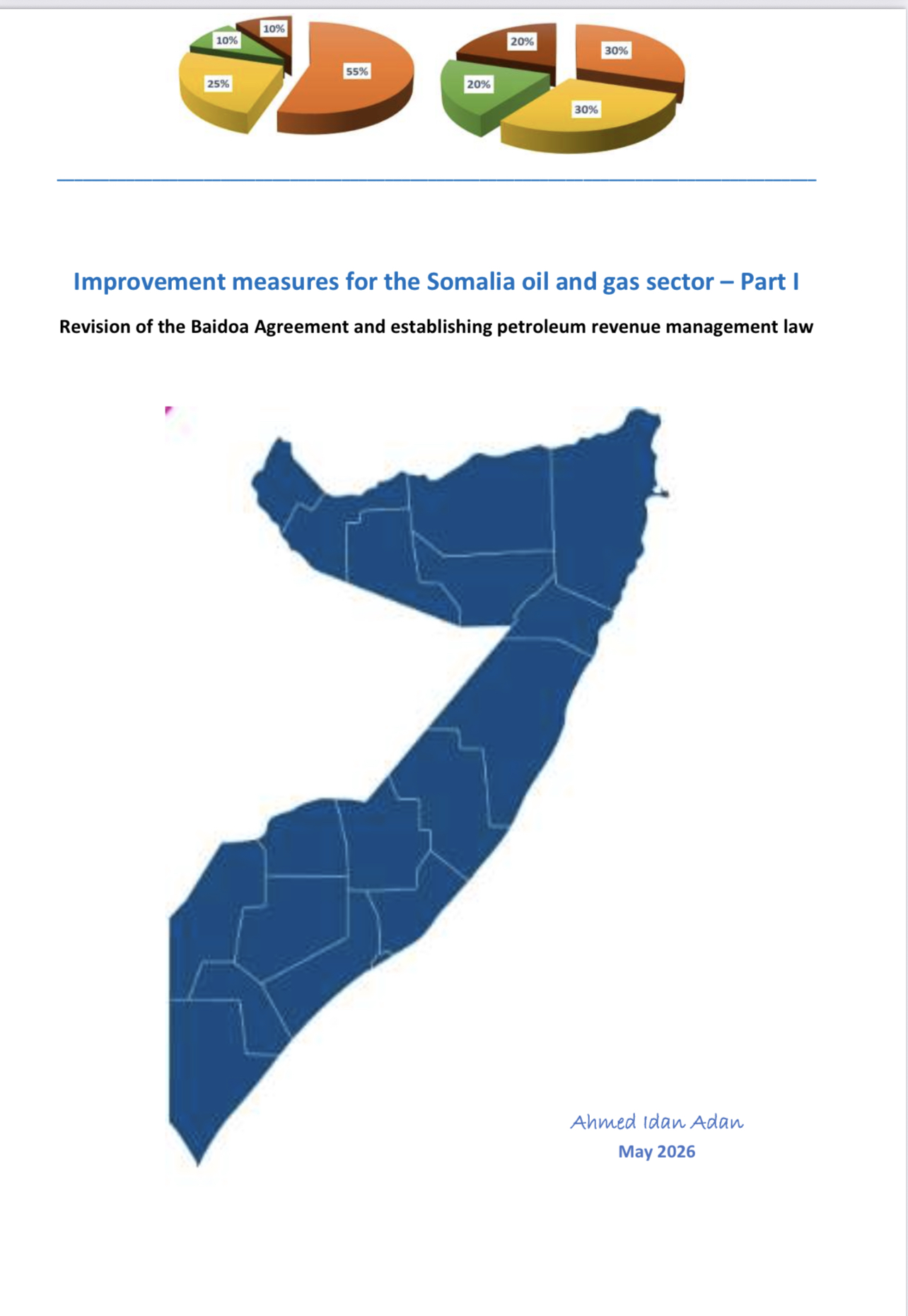
Revision of the Baidoa Agreement and establishing the petroleum revenue management law
Ahmed Idan Adan
May 2026
________________________________________________________________________________________
1
Oil and gas investment necessitates a comprehensive legal and regulatory framework due to the sector’s high
capital intensity and long-term nature. At the national level, such a framework typically comprises policies,
laws, and regulations that govern the industry. In addition, contractual agreements between host
governments and investing companies play a critical role. These contracts are often area-specific, outlining
the rights and obligations of the parties involved, and commonly include provisions related to operational,
financial, social, environmental, and production responsibilities.
Sectoral legislation, commonly referred to as petroleum law, act, or code, serves as the primary source of
regulatory authority. It generally addresses the roles and responsibilities of relevant governmental
institutions, licensing procedures, and the regulation of petroleum activities. Furthermore, it establishes
fiscal terms and includes provisions related to health, safety, and environmental standards, labor
requirements, local content, data management, and public accountability.
Supplementing this legislative framework is the petroleum revenue management law, which is equally
important. This law governs the collection, allocation, and management of petroleum revenues. Its primary
objective is to ensure that such revenues are managed in a responsible, transparent, and sustainable manner
for the benefit of present and future generations.
Petroleum revenue refers to the total income received by a government from the exploration, development,
and commercialization of crude oil and natural gas. This includes revenues derived from royalties, taxes,
signature bonuses, fees, government profit shares, and state participation in petroleum operations.
Petroleum revenue has unique characteristics. It is inherently finite and subject to significant volatility due
to fluctuations in global prices and production levels, making it an unreliable revenue source over the long
term. The sector also generates large economic rents that are geographically specific, which may contribute
to disputes and governance challenges. Given these characteristics, petroleum revenues require specialized
management and distribution mechanisms that differ from other types of government revenue.
Revision of the Baidoa Agreement
Despite recent progress in the development of the oil and gas sector, including the establishment of much of
the necessary legal framework, Somalia has yet to enact a comprehensive petroleum revenue management
law. Currently, the primary instrument governing petroleum revenue is the Agreement on Ownership,
Administration and Sharing of Revenues from Natural Resources (Petroleum and Minerals), commonly
referred to as the Baidoa Agreement.
This agreement, concluded in 2018 in Baidoa, represents a political framework negotiated between the
Federal Government of Somalia (FGS) and the Federal Member States (FMS). It was developed by a Technical
Committee for Facilitation and Negotiation on Federal Affairs with the objective of establishing principles for
revenue sharing from petroleum and mineral resources. The agreement has played a significant role in
2
reducing political tensions and currently serves as the principal reference point for revenue-sharing
arrangements in Somalia.
However, the Baidoa Agreement remains an incomplete framework. It lacks the necessary legal back-up,
detailed fiscal provisions, and institutional mechanisms required for effective implementation. Given that
approximately eight years have elapsed since its adoption, and considering the progress made in sector
development, there is a need to revise the agreement and integrate it into a comprehensive and legally
binding petroleum revenue management law.
Unlike the Baidoa Agreement, which was deliberated and negotiated by a limited group of political actors,
some of whom may not have possessed sufficient familiarity with the characteristics of the petroleum sector,
a formal legislative framework, such as a petroleum revenue management law, should be drafted by the
relevant competent institutions. Such legislation should also be subject to broader public participation
through structured and transparent public consultation processes before its submission to Parliament for
consideration and approval. Meaningful public engagement would not only provide valuable practical input
to the legislative process but would also strengthen the legitimacy, transparency, accountability, and
inclusiveness of the governance framework for natural resource revenues.
As the sector continues to advance and initial revenues begin to materialize for some of the licenses, the
The establishment and transparent implementation of a comprehensive revenue management law is critical.
Such a framework is essential to ensure the effective, equitable, and sustainable utilization of petroleum
resources, while mitigating the risks associated with the resource curse.
As illustrated in the table above, the listed petroleum fiscal revenues are distributed among the Federal
Government of Somalia, the petroleum-producing regional state, and the producing district within that regional state
Baidoa Agreement’s list of sub-national revenue sharing components list
3
state, and the non-producing regions. The first two revenue categories relate to profit oil sharing from
offshore and onshore petroleum operations. It should be noted that these allocations do not represent the
total government takes from production-based revenues, which ordinarily comprise royalty, profit oil share
plus corporate income tax.
The table indicates that corporate income tax, at a rate of 30 percent, is allocated exclusively to the Federal government
Government. From a fiscal administration perspective, the sub-national allocation of production-based
revenues, namely royalty, profit oil share, and corporate income tax could be consolidated into a single
revenue category for both offshore and onshore operations, rather than being presented as separate line
items.
Furthermore, the allocation of offshore profit oil appears disproportionately tilted against the non-producing
regions. Under the current framework, the Federal Government receives 55 percent of offshore profit oil
share, while non-producing regions are allocated only 10 percent. Such an arrangement may not adequately
support the national cohesion and equitable resource-sharing principles that are essential to Somali unity
and state-building process. This is particularly notable given that the governing agreements explicitly
emphasize that resource-sharing arrangements should promote national unity (Article 3 of the Baidoa
Agreements). This imbalance could be addressed through several alternatives, including a reduction in the
Federal Government’s allocation, an increase in the share allocated to non-producing regions, or a
restructuring of the allocation framework whereby the non-producing regions’ share is integrated into the
Federal Government’s portion for subsequent internal redistribution.
Similarly, the onshore profit oil allocation appears heavily skewed in favor of the producing regional state
and its districts. The producing regional state is allocated 50 percent of the national profit oil share. A more
balanced allocation would be in the range of 30 to 35 percent.
Profit oil sub-nations distribution offshore and onshore
Sub-national profit oil sharing – offshore Sub-national profit oil sharing – onshore
4
In addition, the list of revenue categories does not comprehensively capture all potential government
revenues arising under the production sharing agreement framework. For example, the current Somali
production sharing agreement model provides for a withholding tax of 5 percent on gross remittances made
by contractors to subcontractors. Given that subcontracting activities in the upstream petroleum sector may
involve projects valued in the tens of millions of dollars, such tax revenues could be significant. However, the
Baidoa Agreement does not clearly specify how such revenues are to be allocated.
Likewise, the agreement does not sufficiently address revenues arising from penalties associated with
contractors’ failure to fulfill minimum work and expenditure obligations during exploration phases, including
seismic acquisition and exploratory drilling commitments. Such payments may amount to several million
dollars, yet the absence of a clearly defined allocation mechanism creates potential legal and fiscal
uncertainty.
The Baidoa Agreement also fell short of establishing a clear mechanism to address the finite and volatile
nature of petroleum revenues. As an intergovernmental agreement rather than a comprehensive petroleum
revenue management law, the Baidoa Agreement was not structured to accommodate detailed provisions
on this matter. Consequently, the consideration of future generations is only mentioned in Article 3 of the
Baidoa Agreement, without any commitment to specific revenue allocations or any indication that such
allocations would subsequently be provided for under implementing regulations.
In conclusion, Somalia’s petroleum sector institutions should urgently establish a comprehensive petroleum
A revenue management framework to regulate the collection, management, investment, and sub-national
distribution of petroleum revenues. Such legislation should also provide for the establishment of sovereign
petroleum funds, including a stabilization fund and a future generation’s fund, together with their
governance structures, fiscal rules, investment mandates, advisory mechanisms, and committees.
Furthermore, the Baidoa Agreement requires amendment to ensure a more equitable and balanced
distribution of petroleum revenues that promotes national unity and delivers broad-based economic
benefits. The current allocation framework disproportionately favors the Federal Government and
producing regions while limiting the participation of non-producing regions. In addition, the agreement
remains incomplete, as several potential revenue streams lack clearly defined allocation formulas, creating
avoidable legal and fiscal ambiguity.
(a) One-off payments, such as bonuses, penalties, and data sales.
(b) Annual payments, such as surface rental fees, administrative fees, capacity building, and other recurring
financial obligations tied to the contract area.
(c) Activity-based and production-based revenues, including royalties, various forms of taxation, profit oil
share, government participation, and other production-linked fiscal instruments.
Written by Ahmed Idan Adan